


Consumers benefit from choice and markets.
That’s not a particularly complex concept. But it’s always impressive to see companies that benefit from consumers not having choices argue against facts and common sense.
In the late 1990s, Ohio’s energy market was partially deregulated, and consumers were given more choice with their energy options. However, despite Ohioans being better off, many of the state’s utility companies longed to return to the days of over-regulation and monopoly energy control.
In the spring of 2024, the increase in large-scale data centers, advanced manufacturing, and the advent of AI had pushed Ohio’s energy demand to new highs. The state was at an inflection point. It could embrace more pro-consumer energy policies, or it could reinstate burdensome regulations that restricted options and padded energy companies’ bottom lines.
The Buckeye Institute recognized this once-in-a-generation opportunity to stand up for consumers and improve the state’s energy outlook. So they got to work.
Markets in everything
Buckeye’s team knew they needed data and information to show the benefits of free-market energy policies. They would also need to educate Ohioans on what different energy policies would mean for them and their families. So, Buckeye developed a comprehensive plan.
First, they organized a coalition of tech companies, the Ohio Manufacturers’ Association, Americans for Prosperity-Ohio, and other grassroots allies and industry partners.
Next, Buckeye’s team produced research and data-based reports showing the tangible benefits of free-market energy policies. Buckeye’s reports also showed the dangers of going back to anti-consumer policies of over-regulation.
Then, armed with their research, Buckeye’s team and coalition members attended multiple energy conferences to educate stakeholders and policymakers on the need for comprehensive energy reform. Buckeye and their coalition met frequently with lawmakers to provide behind-the-scenes counsel and expert committee testimony at the statehouse.
The result of all this work was House Bill 15.
Ohio House Bill 15 would make Ohio’s energy options more affordable and reliable. The bill allows Ohio to achieve its energy needs without passing along the costs to residential or smaller commercial energy consumers.
Some of House Bill 15’s elements include:
- Repealing taxpayer-funded subsidies to multi-billion-dollar utility companies. These subsidies would have cost Ohioans $582 million over the next four years.
- Making electricity prices more market-based.
- Requiring greater transparency from utility companies.
- Limiting utility companies’ ability to put complicated and hard-to-understand riders on consumers’ utility bills.
- Cutting regulations and taxes for infrastructure and new energy generation.
- Enabling more energy competition to keep prices low.
- Eliminating vertically integrated, state-regulated energy monopolies where state regulators approve both generation and transmission costs.
- Requiring power grid “heat maps” that will facilitate economic development by showing areas of availability and constraint.
Locking in reform
To get House Bill 15 over the finish line, Buckeye’s team leveraged their coalition to reach as many taxpayers (and voters) as possible and deliver critical facts.
First, Ohioans needed to know utility companies took hundreds of millions in energy subsidies from the corrupt bill that ultimately landed the former Ohio House Speaker in prison for bribery.
Second, Ohioans needed to understand how important affordable energy is to spur new technology and economic development in the Buckeye State.
And finally, Ohioans needed to see how taxpayer-funded subsidies have only led to higher consumer costs and less choice.
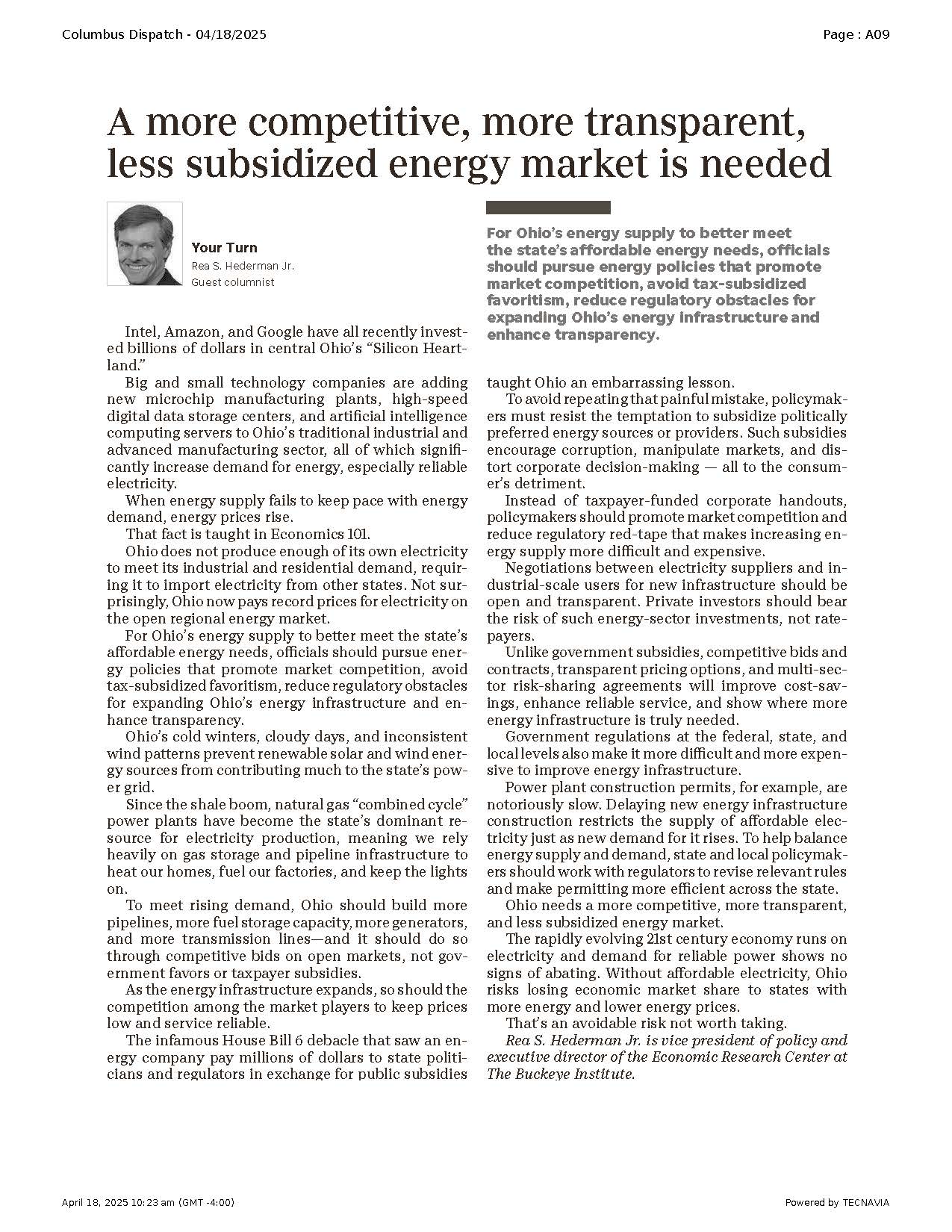
Buckeye’s team delivered these messages statewide through a robust marketing and media campaign. They also delivered these messages to lawmakers directly.
And the messages worked.
Thanks in large part to Buckeye’s work, Ohio passed House Bill 15 in the summer of 2025.
Rea Hederman, a member of SPN’s Energy Working Group and vice president of policy at Buckeye summarized the significance of this win:
“With the signing of House Bill 15, Ohio is now a national leader in smart, free-market energy policy. While more work remains to ensure cost transparency and protect consumers from overpaying for costly infrastructure, The Buckeye Institute-championed policies are pro-consumer and pro-business—ending costly, uncompetitive subsidies, bringing back greater predictability in public utility rate cases, and incentivizing new energy development.”
Because of their work making House Bill 15 a reality, The Buckeye Institute was a finalist for the 2025 SPN Bob Williams Award for Biggest win for Freedom.
Consumers benefit from choice and markets. Period. Thanks to the Buckeye Institute, Ohio consumers have (and will continue to have) desperately needed choice and markets in their energy.